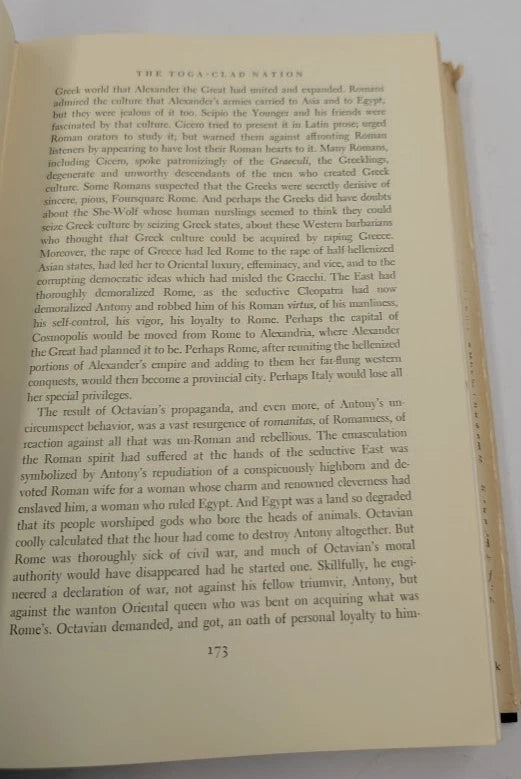
Mask of Jove Stringfellow Barr 1st Edition
Mask of Jove Stringfellow Barr 1st Edition
Stringfellow Barr
 Good
Good
This Book is Pre-Owned and Vintage, please see all photos - Integrity is good - there is some minor tears to dust jacket- Previous owner name inside cover
Free shipping Australia-wide
Couldn't load pickup availability
THE MASK OF JOVE, by Stringfellow Barr, is a history with two major dimensions. It can be read as a history of the rise, decline, and, at least in the West, the fall of Roman power over some seven centuries - a dramatic and moving story complete in itself. Or it can be read as the second volume of The Will of Zeus (published by Lippincott in 1961), continuing the story of the development and final decay of Hellenic culture. It is written in a swiftly moving narrative style which conveys a kind of suspense even to readers familiar with the period. Wherever available documents permit, the characters in the history are allowed to tell their own stories through direct quotation.
The Will of Zeus tells the story of Greek culture from its origins to the death of Alexander the Great in 323 BC; The Mask of Jove continues the story through the Hellenistic period, the Roman conquest of Greece in 146, and the centuries of the Roman Empire up to the death of Constantine, ruler of the Christian "Roman" Empire. The Mask of Jove is, therefore, at least chronologically, a history of Rome; but its underlying theme is the continued development of Greek civilization as expressed in Greek literature, as reflected in Latin literature, as carried on by Greek mathematicians and scientists, and as recorded by Greek or hellenized painters, sculptors and architects.
The Mask of Jove may well be even more widely read than the eminently successful Will of Zeus, for the men and women who move through its pages are much like those of our own generation. The great military and financial network of power which men called the Roman Empire resembles America today far more than Athens ever did.
The reader will recognize contemporary American problems in the political contests and scandals throughout Roman history; the frequent hunts for subversives; the crises in traditional morality; the religious skepticism so curiously combined with patriotic piety on the one hand and with genuine religious searchings on the other; the transformation of a rural population into a rootless proletariat, crowded into large cities and living largley by its wits; the purchased culture of the nouveaux riches; the never-ending stream of propaganda and the practice of news management; the love of size, the vulgar display of wealth; the psychological alienation, anxiety, and loneliness of the individual lost in a mass society. The reader will also recognize the confrontation of force, parading as moral authority, with a dissenting movement of nonviolence.
The title, The Mask of Jove, reflects that which is painfully familiar today: the Roman knack for projecting image, status, front, slogans, self-righteousness, moralizig; for masking military force and financial power with great religionity.
It is these features of society during the Roman period which make The Mask of Jove a mirror held up to America today and inevitably lead the reader to wonder whether his society too will decline and fall as the Western Empire did, ossify into Byzantinism as the Eastern Empire did, or take its own unpredictable direction.
- ISBN: Not Applicable
- Publisher: Lippincott
- Year: 1966
- Binding: Hardcover