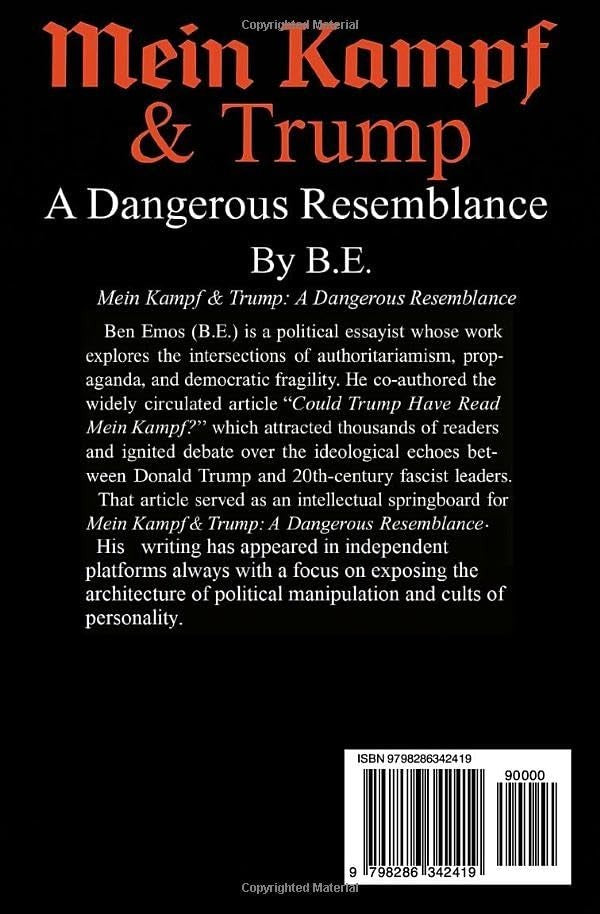
Mein Kampf and Trump a Dangerous Political Resemblance by Ben Emos Analysis
Mein Kampf and Trump a Dangerous Political Resemblance by Ben Emos Analysis
Emos, Ben
 Brand New
Free shipping Australia-wide
Couldn't load pickup availability
In "Mein Kampf & Trump: A Dangerous Resemblance," author Ben Emos examines the unsettling parallels between historical and contemporary political rhetoric.
This thought-provoking analysis delves into themes of nationalism, populism, and the manipulation of public sentiment, making it essential reading for those interested in political science and history.
Emos, known for his incisive commentary, invites readers to reflect on the implications of these comparisons in today's sociopolitical landscape. This edition is particularly relevant for scholars, students, and anyone seeking to understand the dynamics of power and ideology.
Carefully packed and dispatched by Pearl Press.
Mein Kampf & Trump: A Dangerous Resemblance
Overview of the Book’s Central Themes
What if the warnings of history were not behind us—but repeating, louder than ever?
In this fearless, deeply researched, and unnervingly timely work, Mein Kampf & Trump: A Dangerous Resemblance draws haunting parallels between the authoritarian rise of Adolf Hitler and the populist machinery of Donald Trump. But this is not just a historical comparison. It is a wake-up call.
With journalist-level documentation and a voice sharpened by exile from the public eye, author B.E. explores the ways fear, propaganda, and power distort democracy from within. Through twenty-seven intricately woven chapters, the book unpacks the weaponization of religion, social media, money, law, nationalism, and truth itself.
This is not a partisan work—it is a moral one. And it asks the hardest question of all: If we know the signs, why do we keep ignoring them?
1. The Power of Grievance
Both Hitler and Trump rose to power by cultivating a sense of betrayal in the national psyche. In post-WWI Germany, Hitler seized on the Treaty of Versailles and economic ruin to stoke rage. In post-recession America, Trump framed globalism, immigration, and racial progress as threats to a fading vision of greatness. The result was the same: a politics built not on hope, but on vengeance.
Grievance became a fuel—converted into chants, policies, enemies. It allowed people to explain their suffering not through systems, but scapegoats. For both leaders, that sense of loss was not something to heal; it was something to weaponize.
2. The Creation of the Enemy Within
In Nazi Germany, the enemy was the Jew, the communist, the outsider. In Trump’s America, it has been the immigrant, the journalist, the protestor. Entire groups have been painted as existential threats to national identity. Once that fear is established, it justifies surveillance, detention, and even violence.
What begins as suspicion becomes law. What starts as rhetoric becomes reality. And slowly, the circle of who "belongs" begins to tighten.
3. The Death of Truth
Both men understood that facts are negotiable when emotion rules. Hitler used state media and censorship to create a closed loop of information. Trump, born into the age of algorithms, didn’t need state control—he had social media. His genius was in turning “fake news” into a shield, creating an alternate reality where truth bends to loyalty.
In both regimes, the aim wasn’t to convince everyone. It was to confuse just enough people that no one could agree on what was real.
4. The Spectacle of Power
Authoritarianism rarely arrives in black-and-white. It comes with fanfare, rallies, flags, slogans. Hitler had Nuremberg. Trump had the Capitol steps. Both leaders understood the power of theater—the optics of dominance, the illusion of unity. The crowd doesn’t just watch; it becomes part of the performance.
When politics becomes entertainment, truth becomes a prop, and democracy becomes a stage.
5. The Corruption of Institutions
This book traces how both figures hollowed out the guardrails meant to check them. Courts stacked.
Agencies gutted. Critics fired or threatened. When loyalty is the only currency, governance becomes personal—and dangerous.
From Hitler’s Enabling Act to Trump’s executive overreach, we see how democracies are not destroyed overnight. They are dismantled, piece by piece, by people in suits with pens and legal memos.
This book is not prophecy. It is a mirror.
- ISBN: 9798286342419
- Year: 2025
- Binding: Paperback