Outsmarting Agile Adversaries in the Electromagnetic Spectrum by Padmaja Vedula
Outsmarting Agile Adversaries in the Electromagnetic Spectrum by Padmaja Vedula
Lance Menthe, Abbie Tingstad, Karishma R. Mehta
 Brand New
Free shipping Australia-wide
Couldn't load pickup availability
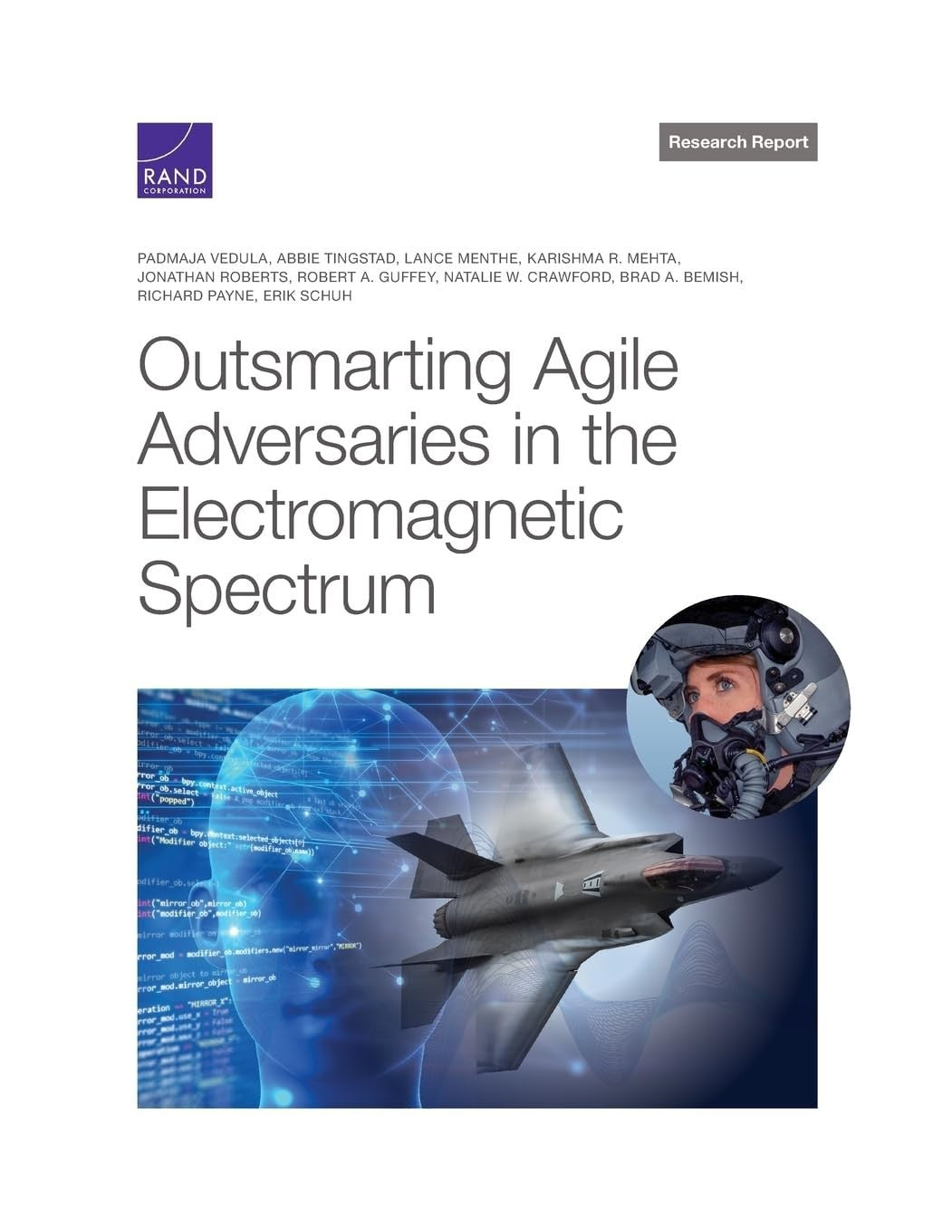
RAND researchers conducted case studies comprising key elements necessary for creating near-real-time, autonomous, inflight software reprogramming and artificial intelligence-enabled cognitive electronic warfare capabilities for the U.S. Air Force.
The U.S. Air Force's electronic warfare integrated reprogramming (EWIR) enterprise examines intelligence on adversary threats that emit in the electromagnetic spectrum (EMS) (in particular, radars and jammers) and configures electronic warfare software and hardware to enable aircraft or other resources to react to and/or respond to adverse changes in the EMS environment. With the growing advancements in U.S. adversaries' electronic warfare assets that enable complex and diverse EMS capabilities, identifying, tracking, and responding to these threats requires much faster updates than the existing EWIR enterprise was designed for. The research team conducted four interrelated technology case studies that together comprise the fundamental elements necessary for creating a near-real-time, autonomous, inflight software reprogramming capability and, more specifically, artificial intelligence–enabled cognitive electronic warfare capabilities—the use of machine learning algorithms that enable platforms to learn, reprogram, adapt, and effectively counter threats in flight. The research team also highlighted important continuing roles for the existing EWIR enterprise even as the U.S. Air Force moves toward a cognitive future.
Key Findings
- To remain competitive and adapt to changing threats, U.S. Air Force (USAF) systems that operate in the EMS must be capable of rapid reprogramming (including evaluating the environment, detecting adversary activity, and synthesizing an appropriate response), at least on the order of seconds to minutes, in order to effectively react to the most advanced threats.
- Agile software solutions, hardware upgrades, data engineering, and interoperability with other systems are all required to achieve the needed speed.
- Accompanying changes in policy, organizational mission alignment, personnel and computing availability, and personnel professional development are also needed.
- ISBN: 9781977410573
- Publisher: rand corporation
- Year: 2023
- Binding: Paperback
- Page count: 174 pages